The 5-Minute Rule: Why Kamloops Businesses Lose 21x More Customers
The Brutal Truth About Lead Response Time
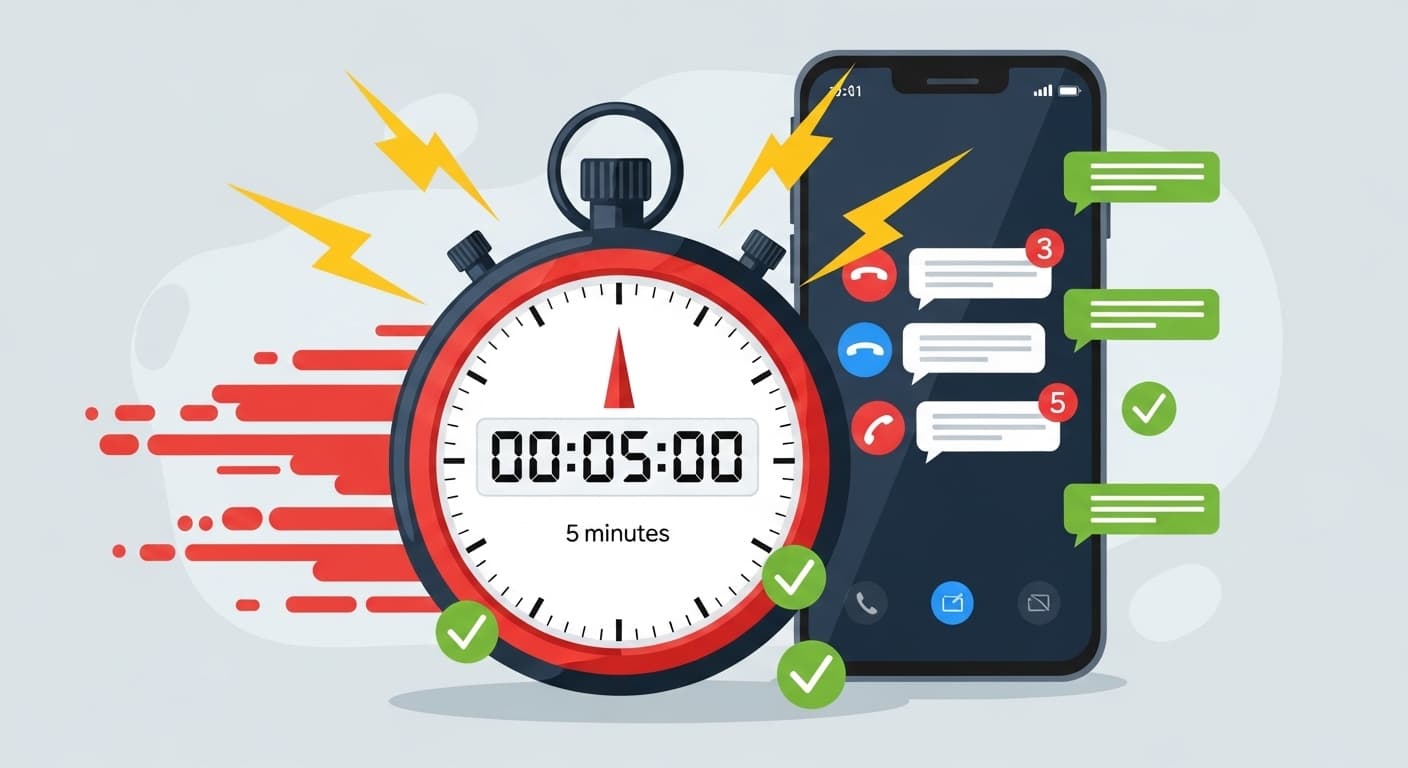
Here's a statistic that should terrify every service business owner: Harvard Business Review research proves that responding to a lead within the first 5 minutes makes them 21 times more likely to qualify compared to a 30-minute delay.
Read that again. Twenty-one times.
The lead's interest and urgency decay rapidly with every passing minute. After 5 minutes, your chances of converting that lead drop dramatically. After 10 minutes, they've probably already called your competitor. After an hour, they've forgotten they even contacted you.
Yet in 2026, the average business response time is still over 4 hours. And 62% of companies fail to respond to leads at all.
This isn't just a minor inefficiency. This is money walking out the door every single day.
Why This Matters for Kamloops Service Businesses
Let's talk about what actually happens when someone needs your service:
It's 9 PM on a Tuesday. A homeowner in Aberdeen discovers water pooling under their kitchen sink. They grab their phone and search "emergency plumber Kamloops."
They see three businesses in the Local Pack. They call the first one. Voicemail.
They call the second one. Voicemail.
They call the third one. Someone answers immediately, asks a few questions, and books them for a service call within the hour.
Guess who gets the job? Guess who gets a $500 emergency service call plus a potential lifetime customer?
It's not the business with the best website. It's not the business with the most experience. It's the business that answered the phone.
This scenario plays out hundreds of times per day across Kamloops. And if you're not answering, you're losing.
The Real Cost of Missed Calls
Let's do the math for a typical Kamloops service business—plumbing, HVAC, electrical, whatever:
Average job value: $500
Missed calls per week: 10
Conversion rate if you answered: 40%
Lost revenue per week: $2,000
Lost revenue per year: $104,000
That's over $100,000 in revenue walking away because you couldn't answer the phone fast enough.
But it gets worse. Those aren't just one-time jobs. Each customer has a lifetime value. If the average customer is worth $2,000 over their lifetime (repeat service, referrals, etc.), you're actually losing:
4 customers per week × $2,000 lifetime value = $8,000 per week in lifetime value
$8,000 × 52 weeks = $416,000 per year in lost lifetime value
Nearly half a million dollars. Because you didn't answer the phone.
Why You Can't Answer Every Call (And Why That's Okay)
Here's the thing: you're busy. You're on a job site. You're under a sink. You're on a ladder. You're in a meeting. You're having dinner with your family.
You can't answer every call. And you shouldn't have to.
The old solution was to hire a receptionist. But that's expensive ($35,000-$45,000 per year plus benefits), they're only available during business hours, and they can't handle multiple calls simultaneously.
The new solution is instant response automation.
How Instant Response Systems Work
Modern instant response systems answer every call, text, and email within 60 seconds—24 hours a day, 7 days a week, 365 days a year.
Here's what they can do:
Answer Basic Questions
"What are your hours?" "Do you serve Sun Peaks?" "How much does a water heater installation cost?" "Are you licensed and insured?"
These questions don't require your expertise. They just need accurate, immediate answers.
Check Your Calendar and Book Appointments
The system connects to your scheduling software. When a customer wants to book, it checks your availability and books them into the next open slot.
"I need my furnace serviced." → "I can get you scheduled for Thursday at 2 PM or Friday at 10 AM. Which works better?"
The customer picks a time, gets a confirmation text, and it's in your calendar. No back-and-forth. No phone tag.
Qualify Leads
Not all calls are equal. An emergency water heater failure is more urgent (and more valuable) than someone asking for a quote on a bathroom renovation next spring.
The system asks qualifying questions:
- "Is this an emergency or routine service?"
- "Are you a homeowner or renter?"
- "When do you need this completed?"
- "What's your budget range?"
Based on the answers, it prioritizes the lead and routes it appropriately.
Route Urgent Calls
For true emergencies, the system can immediately connect the caller to your on-call technician. No voicemail. No delay. Instant connection.
Send Confirmation and Reminders
After booking, the customer gets a confirmation text with the date, time, and technician name. They get a reminder 24 hours before. They get a "we're on our way" text when you leave for their location.
This reduces no-shows and makes you look incredibly professional.
Follow Up with Leads Who Didn't Book
Someone called asking about furnace maintenance but didn't book immediately? The system follows up the next day:
"Hi, this is Joe's Plumbing. You inquired about furnace maintenance yesterday. We have openings this week if you'd like to schedule. Reply YES to book or call us at 250-XXX-XXXX."
This alone recovers 20-30% of leads that would have been lost.
Real Results from Kamloops Businesses
Let me share a real example from a local HVAC company that implemented instant response in January 2026.
Before (December 2025):
- Average lead response time: 4.5 hours
- Calls answered after hours: 0%
- Lead-to-booking conversion rate: 22%
- Monthly revenue: $42,000
After (March 2026 - 90 days later):
- Average lead response time: 45 seconds
- Calls answered after hours: 100%
- Lead-to-booking conversion rate: 58%
- After-hours bookings: 18 per month (previously 0)
- Monthly revenue: $54,400
- Additional monthly revenue: $12,400
The system cost them $200 per month. It generated an additional $12,400 per month. That's a 6,200% ROI.
But the numbers don't tell the whole story. The owner told me:
"I used to dread evenings and weekends because I knew I'd miss calls. Now I actually relax. The system handles everything, and I wake up to booked appointments. It's changed my life."
The Psychology of Instant Response
Why does instant response work so well? Psychology.
Reciprocity
When you respond instantly, the customer feels valued. They're more likely to reciprocate by booking with you rather than continuing to shop around.
Commitment and Consistency
Once someone has engaged with your business (even just answering a few questions), they're psychologically committed. They're less likely to start over with a competitor.
Scarcity and Urgency
"I have an opening tomorrow at 2 PM or Thursday at 10 AM" creates urgency. The customer feels they need to book now or lose the slot.
Social Proof
Instant response signals competence and professionalism. "If they're this responsive before I'm even a customer, imagine how they'll treat me after."
Common Objections (And Why They're Wrong)
"My customers prefer talking to a real person."
Your customers prefer getting their problem solved quickly. They don't care if it's a person or a system—they care about results.
Plus, for complex questions, the system can say "Let me connect you with our team" and transfer to a human. Best of both worlds.
"What if the system makes a mistake?"
Systems are trained on your specific business. They know your services, pricing, policies, and availability. They make fewer mistakes than tired humans at 11 PM.
And if something does go wrong, you can review every interaction and fix it. You can't do that with phone calls you never answered.
"I don't want to seem impersonal."
What's more impersonal: instant response with helpful information, or voicemail?
Customers don't feel like they're talking to a robot. They feel like they're talking to a responsive, professional business.
"It's too expensive."
A receptionist costs $35,000-$45,000 per year. An instant response system costs $2,400-$3,600 per year.
And unlike a receptionist, it works 24/7, never calls in sick, never takes vacation, and can handle unlimited calls simultaneously.
If it books just one extra job per month, it pays for itself.
Implementation: The 30-Day Plan
Week 1: Setup
- Choose your system and sign up
- Provide your business information (services, pricing, policies)
- Connect your calendar and phone system
- Train the system on common questions
Week 2: Testing
- Test every scenario (emergency calls, routine bookings, questions)
- Refine responses based on testing
- Set up integrations with your CRM and accounting software
Week 3: Soft Launch
- Route 50% of calls to the system, 50% to your old method
- Monitor performance and customer feedback
- Make adjustments as needed
Week 4: Full Launch
- Route 100% of calls to the system
- Track metrics (response time, booking rate, revenue)
- Celebrate your newfound freedom
What to Look for in an Instant Response System
Not all systems are created equal. Here's what matters:
Integration
Must connect with your existing tools: calendar, CRM, accounting, phone system. If it's a standalone system, it's useless.
Customization
Must be trained on your specific business. Generic responses don't work. It needs to know your services, pricing, and policies.
Multi-Channel
Must handle phone calls, texts, emails, and website forms. Customers contact you in different ways—the system should handle all of them.
Reporting
Must provide detailed analytics: how many leads, response times, booking rates, revenue generated. If you can't measure it, you can't improve it.
Local Support
Must have support available when you need it. Bonus points if they're local to Kamloops and understand your market.
The Competitive Advantage
Here's the thing: most of your competitors aren't doing this yet. They're still missing calls, losing leads, and wondering why their marketing isn't working.
This is your chance to leapfrog them.
When you're the only business that answers instantly, you win. When you're the only business available at 9 PM on a Tuesday, you win. When you're the only business that makes booking easy, you win.
And once you have this advantage, it compounds. More bookings mean more reviews. More reviews mean higher rankings. Higher rankings mean more calls. More calls mean more bookings.
It's a virtuous cycle that starts with one decision: answer faster.
The Bottom Line
The 5-minute rule isn't a suggestion. It's a requirement for survival in 2026.
Your competitors are getting faster. Your customers are getting more impatient. The gap between "fast enough" and "too slow" is shrinking.
You have two choices:
- Keep doing what you're doing and watch leads go to competitors
- Implement instant response and capture every opportunity
The businesses thriving in Kamloops right now aren't the ones with the biggest marketing budgets. They're the ones that answer the phone.
Be one of them.

About Travis Hutton
Founder of Hutton Tech Solutions. 15 years in construction, Red Seal candidate Carpenter. Helping Kamloops businesses grow through automated customer acquisition systems.